If you’ve ever walked past a playground for tiny kids and wondered why those bright, curved climbers or low-slung swing sets feel so different from the big-kid equipment at the local park, you’ve basically stumbled across the heart of what a preschool play structure is. As a play structure supplier that’s worked with preschools, daycares, and family child care homes for years, I get this question all the time—especially from new directors who are trying to pick the right gear for their little learners (ages 3 to 5, just to set that clear age group). It’s not just a smaller version of the playground equipment you remember from when you were 7. There’s actual thought, research, and even a little science baked into every part of these structures. Play Structure
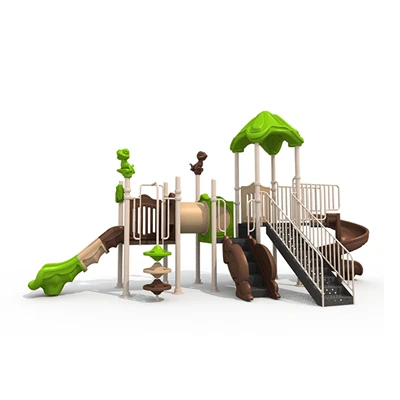
Let’s start with the basics: a preschool play structure is purpose-built equipment designed exclusively for kids 3–5 years old, with safety and early learning front and center. A lot of people mix it up with “infant play structures” or big-kid stuff, but make no mistake—this is a whole separate category. When my team designs and builds these, we’re not just scaling down bolts and slides; we’re matching every part to how a 4-year-old’s brain and body work. Toddlers (under 3) still need lots of floor play and gentle movement, but preschoolers are starting to crave small challenges, social time, and hands-on experiences that prep them for kindergarten. That’s exactly what these structures deliver.
Here’s the part I love breaking down: the science behind why every detail matters. You know how preschoolers are all wobbly but curious? Their gross motor skills are still developing—they’re just learning to climb stairs, balance on a low beam, or grip handrails without squeezing them so tight their knuckles white. So all the handrails on our structures are wider than big-kid rails (think 2 inches instead of 1.5) to fit those tiny, still-growing hands. The platform heights? We cap them at 3 feet max. Big-kid platforms go up to 6 or 8 feet, but a preschooler can’t judge a drop that far yet—we keep it low enough that if they stumble, it’s just a gentle fall onto a soft surface, not a scary one.
Slides are another big one. I remember when I was a kid, slides were steep and fast—my friends and I would race down and scream the whole time. For preschool play structures, we make slides shallower (a 15-degree angle vs. 30 for big kids) and bumpier sometimes, with small “speed bumps” at the bottom. Why? Because 4-year-olds still don’t have full control over their body weight. A steep slide would send them flying forward, which can lead to face plants. Those smaller inclines let them sit upright, hold on, and feel like they’re in charge of their own movement—no panic, just fun. We also add little “landings” at the end of slides, not just straight into mulch. It gives them a second to catch their balance before they run off, which is great for building that coordination.
But here’s where preschool play structures stop being just “safe versions of big playground stuff”—they’re actual learning tools. That’s the stuff that makes our job feel way more important than just selling equipment. Let’s talk about social play: preschool is when kids start learning to share, take turns, and work together. So our structures always have multiple entry points, not just one small door. If your structure only has one way in, you’ll have kids pushing and shoving to get up. With two or three separate paths—like a low climber and a ramp for wheel toys—more kids can play at once, which means they have to practice waiting and asking, “Can I go next?” That’s not just fun; that’s the exact social skill that teachers spend hours every week working on.
We also add “open-ended” elements to every structure. Wait, what’s open-ended? It’s a part of the equipment that can be used in a hundred different ways, not just for one thing. For example, we love adding panel walls with different knobs, mirrors, or chimes. A kid doesn’t have to “use” that wall the right way—they can spin the knobs to make a sound, look at their reflection, or stack a block against it. That’s creativity, spatial reasoning, and even fine motor skills all wrapped into one. We also put little “action panels” low to the ground, right next to the structure, so kids don’t have to climb up to play. That way, even the quieter kids who don’t like climbing can join in the fun without feeling left out.
Don’t get me wrong—safety is non-negotiable, and I don’t take that lightly as a supplier. All our preschool play structures meet strict ASTM (American Society for Testing and Materials) standards for early childhood playground equipment, and we make sure every piece is made of durable, non-toxic materials. No sharp edges, no small parts that can be choked on (even though 5-year-olds are less likely to put everything in their mouths, we still err on the side of caution), and all the metal parts are powder-coated so they don’t get too hot in the sun or too cold in the winter. We also require that every structure is placed on a protective surface—like rubber mulch or poured-in-place rubber— that’s designed to cushion falls from up to 3 feet. Big-kid surfaces are thicker, but again, we match the surface to the structure’s height, so it’s never overkill or not enough.
I’ve seen the difference a good preschool play structure makes, too. A few years back, we sold a set to a small day care center in a suburb outside Chicago. The director told us that before they had our structure, recess was chaotic: kids would wander around, get bored, or fight over the same swing. After a month, she emailed us saying recess now runs smoothly—kids are climbing, working together on the wall panels, and even the kids who used to sit alone on the bench now want to join the climber games. One mom even pulled her aside and said her son, who’d been struggling with sharing, came home that week and told her, “I have to wait for Mia to go down the slide first— that’s how we play at school.” That’s the stuff that makes every bolt and paint job worth it.
A lot of people ask, “Why not just buy cheap big-kid stuff and cut it in half?” The answer is simple: it doesn’t work. Big-kid equipment is designed for older kids with bigger bodies, better balance, and faster reflexes. If you try to scale it down, you end up with something that’s too small to use, too wobbly, or unsafe. Preschool play structures are built for a specific developmental stage, and that’s not something you can hack together. It’s like trying to use a toddler cup for a teenager—just because it’s smaller doesn’t mean it works.
If you’re a preschool director, day care owner, or someone who’s in charge of picking playground equipment for a group of 3–5-year-olds, here’s my advice: don’t just look for the cheapest structure you can find. Ask about the age-specific details—handrail size, platform height, slide angle, and whether the structure has elements that encourage social play. A good preschool play structure isn’t just a place for kids to run around; it’s a space where they learn to problem-solve, make friends, and build the skills they need for kindergarten.

At the end of the day, that’s why we do this. We’re not just a play structure supplier—we’re people who get how important those early years are. If you’re ready to chat about what would work best for your space, want to see examples of our structures, or have questions about safety and design, reach out to our team. We’d love to help you build a playground that your kids will talk about (in a good way) for years.
Play Structure References
- National Association for the Education of Young Children (NAEYC). "Early Childhood Playgrounds: Designing Spaces to Support Growth and Development." 2021.
- ASTM International. "Standard Safety Specification for Playground Equipment for Public Use (F1487)." 2022.
- Berk, Laura E. "Awakening Children’s Minds: How Brain and Biology Drive Early Learning." 2018.
- U.S. Consumer Product Safety Commission (CPSC). "Public Playground Safety Handbook." 2020.
Wenzhou Joyou Amusement Equipment Co., Ltd.
As one of the most professional play structure manufacturers and suppliers in China, we’re featured by quality products and good price. Please rest assured to buy customized play structure made in China here from our factory. Welcome to contact us for pricelist.
Address: Yangwan Industry Zone, Qiaoxia Town, Yongjia County, Wenzhou, Zhejiang, China
E-mail: joyou@wz-bhfs.com
WebSite: https://www.best-playground.com/
